
Related Articles



When it comes to smooth engine performance, many small sensors play a much bigger role than most drivers realize. One of these important components is the throttle position sensor, commonly called the TPS. It may be a small part mounted near the throttle body, but it has a direct effect on how the engine responds when you press the accelerator.
In my view, understanding the throttle position sensor is useful for every car owner because a faulty sensor can create symptoms that are easy to confuse with other engine problems. Poor acceleration, rough idling, hesitation, and even transmission shifting problems can sometimes be connected to incorrect throttle position information.
In this article, I will explain what a throttle position sensor does, how it works, the common throttle position sensor symptoms, what causes it to fail, and how you can diagnose the problem.
What Is a Throttle Position Sensor?
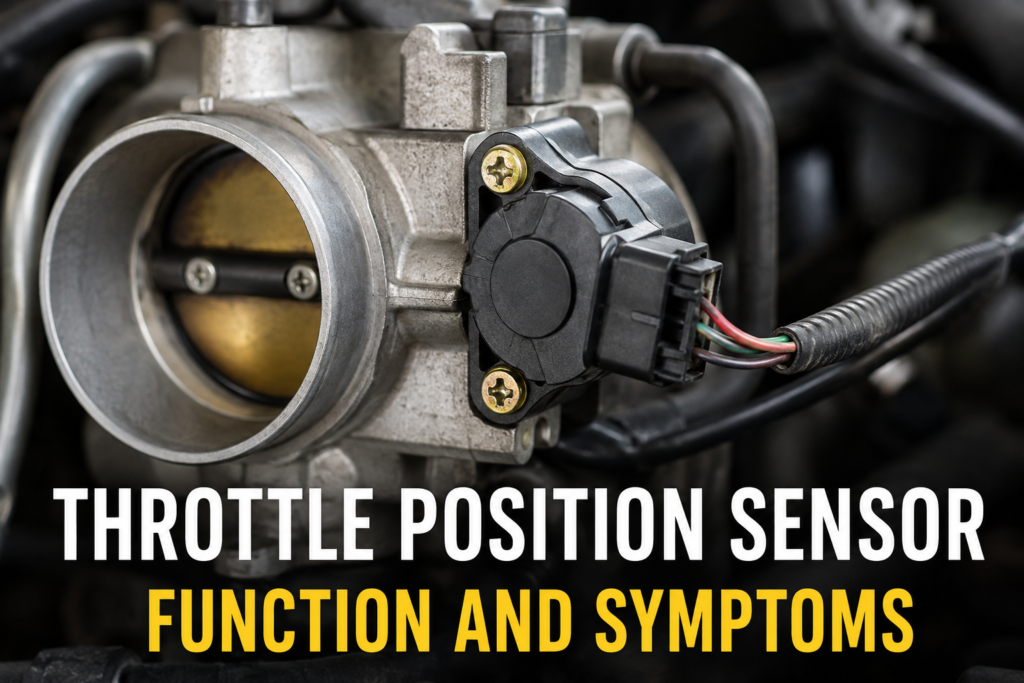
A throttle position sensor is an electronic component that monitors the position of the throttle valve inside the throttle body. The throttle valve controls how much air enters the engine.
When you press the accelerator pedal, the throttle opens to allow more air into the engine. The throttle position sensor detects this movement and sends information to the engine control unit, commonly known as the ECU.
The ECU uses this information along with data from other sensors to control fuel delivery, ignition timing, idle speed, and other engine functions.
In simple terms, the throttle position sensor tells the computer how much you are asking the engine to accelerate.
For example, when the throttle is nearly closed, the ECU knows that the engine is operating at low throttle. When you press the accelerator more, the sensor reports the increased throttle opening so the ECU can adjust engine operation.
How Does a Throttle Position Sensor Work?
The exact design of a throttle position sensor can vary depending on the vehicle. Older systems commonly use a variable resistor, while many modern vehicles use contactless electronic sensing technology.
A traditional TPS changes its electrical signal as the throttle shaft rotates. The ECU receives this changing voltage and interprets it as throttle position.
If the throttle is almost closed, the signal is relatively low. As the throttle opens, the signal changes accordingly.
Modern vehicles may use electronic throttle control instead of a direct mechanical connection between the accelerator pedal and throttle valve. In these systems, the accelerator pedal has sensors and the throttle body also contains position sensors. The ECU compares these signals to control the throttle accurately.
This is one reason modern throttle systems can be more complicated than older mechanical systems.
Main Function of the Throttle Position Sensor
The primary function of the throttle position sensor is to provide accurate throttle position information to the ECU. However, that information affects several important engine operations.
1. Fuel Delivery
The ECU needs to know how much air is entering the engine and how much power the driver is requesting. Throttle position information helps the computer determine the appropriate fuel delivery.
If the TPS signal is incorrect, the engine may receive an inappropriate amount of fuel for the current operating condition.
2. Acceleration Response
A properly working TPS helps the ECU recognize when you press the accelerator. This allows the engine to respond smoothly.
If the sensor has a problem, you may notice hesitation or a delayed response when accelerating.
3. Idle Control
Throttle position information also helps the ECU understand when the throttle is nearly closed. This is important for controlling engine idle.
A faulty sensor can sometimes contribute to unstable or irregular idle speed.
4. Transmission Operation
In vehicles with automatic transmissions, throttle position information can also influence transmission behavior. The ECU or transmission control system uses information about engine load and driver demand to help determine when the transmission should shift.
This means a TPS problem can sometimes appear to be a transmission problem.
Common Throttle Position Sensor Symptoms
A bad throttle position sensor does not always produce exactly the same symptoms. The signs can depend on the vehicle and the way the sensor has failed.
Here are some of the most common symptoms I would look for.
1. Poor Acceleration
One of the most noticeable throttle position sensor symptoms is poor acceleration.
You may press the accelerator and notice that the vehicle does not respond normally. The engine might feel weak, or acceleration may feel slower than usual.
This happens because the ECU may not receive accurate information about the driver’s throttle demand.
2. Engine Hesitation
Another common symptom is hesitation during acceleration.
You may press the accelerator and experience a short delay before the engine responds. In some cases, the vehicle may briefly stumble or feel as if it is losing power.
If the hesitation happens repeatedly, the throttle position sensor should be included in the diagnostic process.
However, I would not replace the sensor immediately because problems with fuel delivery, ignition, air intake, or other sensors can create similar symptoms.
3. Rough or Unstable Idle
A faulty TPS can sometimes contribute to an unstable idle.
The engine may idle higher or lower than expected, or the RPM may move up and down without much input from the driver.
This can happen when the ECU receives an incorrect signal about the throttle position.
Still, rough idle has many possible causes. Vacuum leaks, dirty throttle bodies, fuel problems, ignition issues, and idle control problems can all create similar behavior.
4. Engine Stalling
In more serious cases, a faulty throttle position sensor can contribute to engine stalling.
The engine may stall when you stop at a traffic light, release the accelerator, or attempt to accelerate from a low speed.
If your vehicle is stalling regularly, it is important to diagnose the issue promptly because unexpected stalling can make driving unsafe.
5. Check Engine Light
A malfunctioning throttle position sensor can trigger the check engine light.
The ECU continuously monitors sensor signals. If it detects a signal that is outside the expected range or does not match other sensor information, it may store a diagnostic trouble code.
A scan tool can help identify whether the ECU has detected a TPS related fault.
It is important to remember that a check engine light does not automatically mean the TPS itself needs replacement. Wiring, connectors, throttle body problems, or other sensors can sometimes produce related fault codes.
6. Poor Fuel Economy
A faulty throttle position sensor can also affect fuel economy.
If the ECU receives inaccurate throttle information, fuel delivery may not be optimized for the current driving condition. Depending on the problem, the vehicle may consume more fuel than normal.
If you suddenly notice a significant change in fuel consumption, I would consider checking the entire engine management system rather than blaming one sensor immediately.
7. Transmission Shifting Problems
Some vehicles may experience unusual automatic transmission behavior when throttle position information is incorrect.
You might notice delayed shifting, harsh shifts, or unusual gear changes.
This happens because the transmission control system needs information about engine load and driver demand.
Before assuming the transmission itself is failing, it is worth checking the engine control system and scanning for diagnostic trouble codes.
8. Surging or Jerking
A vehicle with a faulty TPS may sometimes surge or jerk while driving.
The engine may behave as if the throttle is opening and closing even though your foot position has not changed significantly.
This can make the vehicle feel unpredictable, particularly at lower speeds.
What Causes a Throttle Position Sensor to Fail?
Like many electrical and mechanical components, a throttle position sensor can eventually develop problems.
One common cause is normal wear. Traditional sensors may contain internal components that wear as the throttle moves repeatedly over thousands of driving cycles.
Electrical problems are another possibility. Damaged wires, loose connectors, corrosion, or poor electrical connections can interrupt the sensor signal.
Dirt and contamination around the throttle body can also affect throttle operation. In some cases, the sensor itself may be fine while the throttle body has a mechanical problem.
Heat, vibration, moisture, and age can also contribute to sensor failure.
How to Diagnose a Bad TPS
The first step is usually to look at the symptoms and scan the vehicle for diagnostic trouble codes.
A basic OBD scanner can reveal whether the ECU has stored a relevant fault code. However, a code should be treated as a starting point rather than absolute proof that the sensor is defective.
A technician can inspect the wiring and connector and check the sensor signal while the throttle moves.
On some systems, the sensor voltage should increase or change smoothly as the throttle opens. An irregular signal, sudden drop, or inconsistent reading can indicate a sensor or circuit problem.
Modern electronic throttle systems may require more advanced diagnostic equipment and procedures.
Can You Drive With a Bad Throttle Position Sensor?
It may be possible to drive a vehicle with a minor TPS problem, but I would not recommend ignoring it.
A faulty throttle position sensor can affect acceleration, idle quality, fuel economy, and transmission behavior. In some vehicles, the ECU may activate a reduced power or limp mode to protect the engine and maintain basic drivability.
If the vehicle is hesitating badly, stalling, or responding unpredictably to the accelerator, it is safer to have the problem inspected rather than continuing to drive normally.
Does a Throttle Position Sensor Need Regular Maintenance?
The sensor itself generally does not require routine maintenance like engine oil or an air filter.
However, keeping the throttle body clean and maintaining the vehicle’s electrical system can help prevent related problems.
If the throttle body becomes heavily contaminated, it may affect throttle operation and create symptoms that look similar to a TPS problem.
Regular vehicle servicing and paying attention to warning signs can help catch these issues earlier.
Final Thoughts
The throttle position sensor is a small but important part of a modern engine management system. Its main job is to tell the ECU where the throttle is positioned so the computer can make appropriate adjustments to fuel delivery, engine response, idle control, and other functions.
The most common throttle position sensor symptoms can include poor acceleration, hesitation, rough idle, stalling, poor fuel economy, check engine light warnings, transmission shifting issues, and unexpected surging.
From my point of view, the most important thing is not to replace the sensor simply because one of these symptoms appears. Many different engine problems can produce similar signs. Proper diagnosis should include checking fault codes, wiring, connectors, throttle operation, and sensor signals.
If you understand the function of the throttle position sensor, you can recognize potential problems earlier and explain the symptoms more clearly when getting your vehicle inspected. A small sensor can have a major effect on how smoothly and efficiently your engine operates.