Related Articles

When I think about modern car safety, automatic emergency braking is one of the most useful technologies available in many newer vehicles. Driving requires constant attention, but even careful drivers can sometimes react too late when something suddenly appears in front of the car. Automatic emergency braking, often called AEB, is designed to help in these situations by detecting a possible collision and applying the brakes when necessary.
In my view, the most important thing to understand about automatic emergency braking is that it is a driver assistance feature, not a replacement for careful driving. It can provide an additional layer of protection when a driver does not respond quickly enough. In this article, I will explain what automatic emergency braking is, how it works, what sensors it uses, its benefits and limitations, and what drivers should know before depending on this technology.
What Is Automatic Emergency Braking?
Automatic emergency braking is an advanced vehicle safety system that can detect an obstacle or another vehicle in the path of a moving car. If the system believes that a collision may happen, it can warn the driver and, in certain situations, automatically apply the brakes.
The main purpose of automatic emergency braking is to reduce the severity of a crash or prevent a collision completely. The system continuously monitors the area ahead of the vehicle while the car is moving.
For example, imagine that I am driving through city traffic and the vehicle in front suddenly stops. If I fail to notice the situation immediately, the automatic emergency braking system may recognize the rapidly closing distance and determine that a collision is possible. Depending on the vehicle and circumstances, it may first provide a warning and then apply braking force.
How Does Automatic Emergency Braking Work?
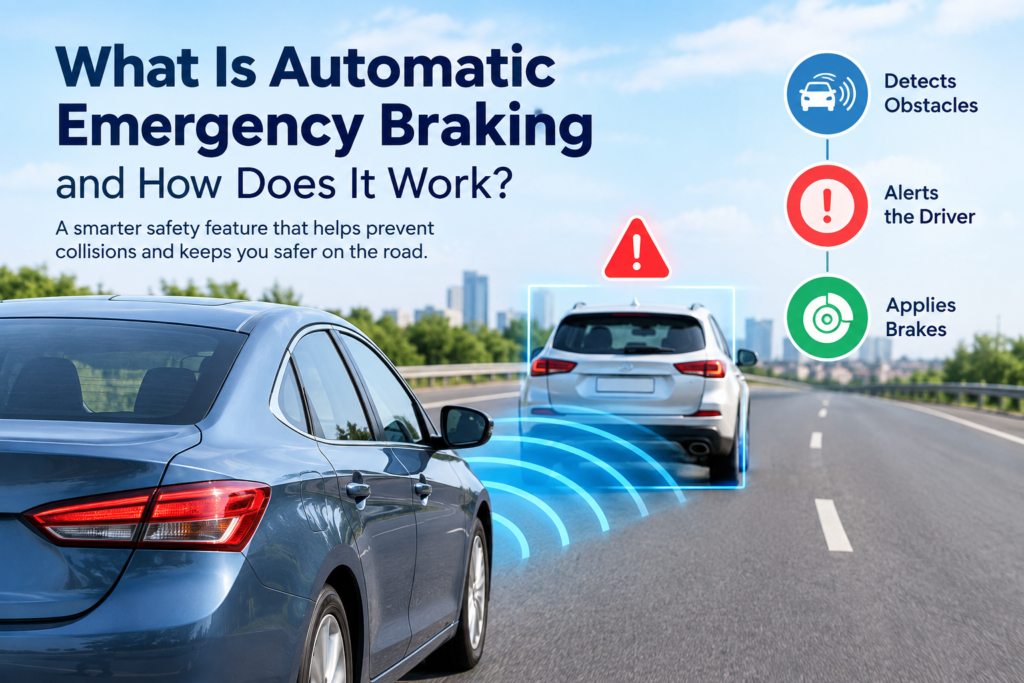
Automatic emergency braking works through a combination of sensors, cameras, computers, and braking components. The exact technology can vary between vehicle manufacturers and models, but the basic process is similar.
First, the vehicle monitors the road ahead. Cameras, radar sensors, or a combination of different sensors can identify vehicles, pedestrians, cyclists, and other objects.
Next, the vehicle computer analyzes information from these sensors. It considers factors such as the distance between the car and an object, the speed of the vehicle, and how quickly the distance is changing.
If the system calculates that a collision could happen, it may alert the driver. The warning can appear on the dashboard, through an audible alert, or through other signals.
If the driver does not respond and the system determines that emergency braking is necessary, it can activate the brakes automatically. The goal is to slow the vehicle as quickly and safely as possible.
What Sensors Does AEB Use?
One interesting part of automatic emergency braking is the technology behind it. Different vehicles use different sensor combinations.
Cameras are commonly used to recognize objects and understand what is happening on the road. A forward facing camera can help identify vehicles, pedestrians, lane markings, and other objects.
Radar sensors use radio waves to detect objects and estimate their distance and movement. Radar can be particularly useful for measuring how quickly a vehicle is approaching another object.
Some advanced vehicles use additional sensing technologies to improve object detection. The exact system depends on the vehicle manufacturer and the safety package installed in the car.
In my opinion, the important point is not which sensor is better by itself. Modern systems often work by combining information from multiple sources so the vehicle can make a more informed decision.
When Does Automatic Emergency Braking Activate?
Automatic emergency braking does not necessarily activate every time a vehicle gets close to another object. The system is designed to evaluate whether there is a meaningful risk of collision.
For example, if I am following another vehicle at a reasonable distance, the system should normally remain inactive. If the vehicle ahead suddenly slows down and the closing distance becomes dangerous, the system may provide a warning.
If the driver responds by braking or steering appropriately, automatic emergency braking may not need to intervene.
However, if the driver does not respond quickly enough, the system may apply the brakes. The amount of braking assistance can depend on the situation, vehicle speed, system design, and available road conditions.
Does AEB Prevent Every Accident?
This is one of the most important questions drivers should understand. Automatic emergency braking cannot prevent every accident.
The system has technological limitations. Sensors may have difficulty detecting certain objects or situations. Heavy rain, fog, snow, dirt, glare, poor visibility, or blocked sensors can affect performance.
AEB may also work differently at different speeds. Some systems are designed mainly for low speed situations, while more advanced systems can operate at higher speeds.
For this reason, I would never treat automatic emergency braking as permission to stop paying attention. The driver remains responsible for controlling the vehicle and watching the road.
Benefits of Automatic Emergency Braking
The biggest benefit of automatic emergency braking is that it can help when human reaction time is not fast enough.
When something unexpected happens, even an attentive driver needs time to recognize the danger, move a foot to the brake pedal, and apply pressure. At higher speeds, a very small delay can make a significant difference.
AEB can potentially reduce the vehicle speed before impact. Even when it cannot avoid a crash completely, reducing the impact speed may help reduce the severity of the collision.
Another benefit is that the system can monitor the road continuously. A driver can become distracted for a moment, become tired, or simply fail to notice something in time. AEB provides an additional safety layer during such moments.
Automatic Emergency Braking and Pedestrians
Some automatic emergency braking systems are designed to recognize pedestrians as well as vehicles. This feature can be especially useful in urban environments where people may cross roads unexpectedly.
The camera and other sensors can identify a person in the vehicle’s path and estimate whether there is a risk of collision. If the driver does not respond appropriately, the system may provide a warning and potentially apply the brakes.
However, pedestrian detection is not perfect. Darkness, poor weather, unusual pedestrian movement, or objects blocking the person’s body can make detection more difficult.
AEB Versus Forward Collision Warning
Automatic emergency braking and forward collision warning are related but they are not exactly the same.
Forward collision warning primarily alerts the driver when the vehicle detects a potential collision. The driver must then take action.
Automatic emergency braking can go a step further by applying the brakes when the system determines that emergency braking is needed.
Some vehicles provide both features as part of the same safety package. I think this combination makes sense because the warning gives the driver an opportunity to respond, while automatic braking can provide additional assistance if the driver does not react quickly enough.
Can AEB Be Turned Off?
Whether automatic emergency braking can be switched off depends on the vehicle. Some manufacturers allow drivers to adjust or disable certain driver assistance features, while other vehicles may automatically reactivate them after the car is restarted.
I recommend checking the owner’s manual rather than assuming how the system works. Drivers should also understand which safety features are active and what warnings they may receive.
It is also important to keep the vehicle sensors and cameras clean. If a sensor area becomes covered with mud, snow, or dirt, the system may provide a warning or become temporarily unavailable.
Limitations Drivers Should Know
Although automatic emergency braking is useful, it has limitations that should never be ignored.
The system may not detect every obstacle. It may also react differently depending on road conditions, speed, lighting, weather, traffic, and the type of object involved.
AEB can sometimes provide warnings when a driver believes there is no danger. This can happen because the system is making calculations based on sensor information.
Drivers should also understand that emergency braking may not be enough to avoid a collision if the vehicle is already too close to an obstacle.
For me, the best way to think about AEB is as a backup system. It is valuable technology, but good driving habits remain the first line of safety.
How Drivers Can Get the Most From AEB
To get the most benefit from automatic emergency braking, I believe drivers should focus on basic vehicle care and responsible driving.
Keep the windshield and sensor areas clean. Follow the manufacturer’s maintenance recommendations. Learn what the warning sounds and dashboard messages mean. Pay attention to system notifications and have the vehicle inspected if a safety system repeatedly reports a fault.
Most importantly, keep your eyes on the road. Do not use AEB as a reason to follow other vehicles too closely or drive while distracted.
Final Thoughts
Automatic emergency braking is an important development in modern vehicle safety. It uses cameras, radar, computer processing, and braking technology to recognize potential collisions and help slow or stop a vehicle when necessary.
From my point of view, its greatest value is the extra reaction time it can provide. A driver may miss something for a moment, but an automatic emergency braking system can continue monitoring the road and potentially respond when a collision becomes likely.
At the same time, no safety technology is perfect. Automatic emergency braking has limitations, and its performance can depend on weather, road conditions, vehicle speed, sensors, and the specific system installed in the car.
The best approach is to use AEB as an additional safety layer while continuing to drive attentively, maintain a safe following distance, and stay prepared to brake or steer when necessary. When used correctly, automatic emergency braking can be a valuable part of a modern vehicle safety system and may help reduce the risk or severity of certain crashes.