
Related Articles


When I think about the parts that help a petrol engine run properly, the ignition coil is one of those small components that deserves more attention. It may not look as important as the engine, battery, or alternator, but without a working ignition coil, the engine cannot create the strong spark needed to burn the air and fuel mixture.
In simple words, an ignition coil takes the relatively low voltage supplied by the car battery and turns it into a much higher voltage. That high voltage is then used to create a spark at the spark plug. This spark starts the combustion process inside the engine cylinder.
Understanding how ignition coils work can make it much easier to recognize ignition problems, understand engine symptoms, and know when a repair may be necessary. In this article, I will explain how an ignition coil works, what it does, the different types, common symptoms of failure, and how to maintain it properly.
What Is an Ignition Coil?
An ignition coil is an electrical component that is part of a car’s ignition system. Its main job is to increase the voltage coming from the battery or charging system to a level high enough to produce a spark at the spark plug.
A typical car battery provides around 12 volts. That amount of voltage is not enough to jump the gap at a spark plug under the conditions inside an engine cylinder. The ignition coil solves this problem by using electromagnetic principles to transform the voltage into thousands of volts.
The exact voltage can vary depending on the vehicle and ignition system, but it can be many thousands of volts. This high voltage travels to the spark plug, where it creates an electrical arc across the spark plug gap.
That small spark may look insignificant, but it plays a major role in engine operation.
How Does an Ignition Coil Work?
The basic working principle of an ignition coil is actually quite interesting. Inside the coil are two sets of wire windings called the primary winding and secondary winding. These windings work together with an iron core to create and transform an electromagnetic field.
The process begins when the engine control system sends electrical current through the primary winding. This current creates a magnetic field around the coil.
When the control system suddenly stops the current flowing through the primary winding, the magnetic field collapses. This rapid change in the magnetic field induces a much higher voltage in the secondary winding.
The secondary winding contains many more turns of wire than the primary winding. Because of this difference, the voltage can increase dramatically.
The high voltage is then sent toward the spark plug. When the voltage becomes high enough, it jumps across the spark plug gap and creates the spark needed for combustion.
Modern ignition systems control this process electronically, allowing the engine computer to determine the appropriate ignition timing based on engine speed, load, temperature, and other operating conditions.
Why Is the Ignition Coil Important?
The ignition coil is important because the engine needs a strong and properly timed spark to burn the air and fuel mixture efficiently.
If the ignition coil produces a weak spark, the engine may not burn the mixture completely. This can cause poor performance, rough running, increased fuel consumption, and higher emissions.
A healthy ignition coil helps the spark plug produce a strong spark at the correct moment. This supports smooth combustion and allows the engine to produce the power expected from it.
From my point of view, the ignition coil is one of those parts that people often ignore until the car starts showing obvious problems. Because the symptoms of a failing coil can sometimes look similar to other engine problems, understanding its role is useful when diagnosing a vehicle.
Types of Ignition Coils
Cars use different ignition coil designs depending on the engine and ignition system.
Single Ignition Coil
Older vehicles often use a single ignition coil. In some systems, the coil sends high voltage to a distributor, which then directs the spark to the appropriate spark plug.
This design is relatively simple but contains more moving and mechanical components than many modern ignition systems.
Coil Pack
A coil pack contains multiple ignition coils in one assembly. Instead of using a traditional distributor, the ignition system electronically controls which coil fires each spark plug.
Coil packs became common as vehicle manufacturers moved toward more electronically controlled ignition systems.
Coil on Plug
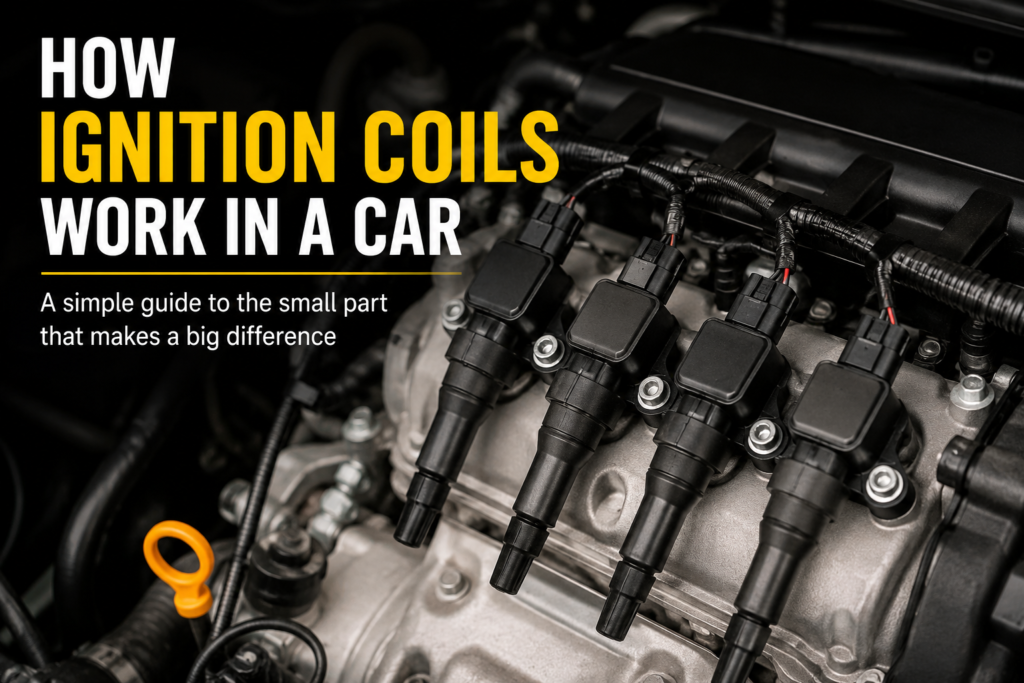
Many modern cars use a coil on plug system. In this design, each spark plug has its own ignition coil positioned directly above it.
This arrangement reduces the distance that high voltage needs to travel. It also allows the engine computer to control each cylinder’s ignition more precisely.
Coil on plug systems are widely used because they can provide reliable ignition performance while reducing the need for traditional high voltage wires.
What Happens When an Ignition Coil Fails?
An ignition coil can eventually wear out or develop an electrical problem. When this happens, the engine may begin showing several noticeable symptoms.
One of the most common signs is an engine misfire. A misfire happens when the air and fuel mixture in one or more cylinders does not burn correctly.
The engine may shake or feel rough, especially when accelerating or when the vehicle is sitting at idle.
Another common symptom is difficulty starting the engine. If one or more coils cannot produce a sufficient spark, the engine may take longer to start or may fail to start altogether.
You may also notice a loss of power. When a cylinder is not firing correctly, the engine cannot produce its normal amount of power. This can become particularly noticeable when accelerating or driving uphill.
Poor fuel economy can also occur. When combustion is incomplete, the engine may consume more fuel than normal.
In some cases, the check engine light will illuminate. Modern vehicles can detect certain ignition problems and store diagnostic trouble codes in the engine control module.
Common Signs of a Bad Ignition Coil
Some of the most common ignition coil failure symptoms include:
- Engine misfires
- Rough idle
- Reduced engine power
- Poor fuel economy
- Difficulty starting
- Check engine light
- Engine hesitation during acceleration
- Increased exhaust emissions
- Stalling in some situations
Not every vehicle will show all of these symptoms. A failing coil can also behave differently depending on whether the engine is cold or hot.
For example, a coil may work normally when the engine is cold but begin to fail after reaching operating temperature. This can make diagnosis more difficult.
Why Do Ignition Coils Fail?
Ignition coils are designed to last for a long time, but they are exposed to heat, vibration, electrical stress, and moisture. These conditions can eventually damage the internal components.
Excessive engine heat is one of the major factors that can shorten ignition coil life. The coil is often located close to the engine, where temperatures can become very high.
Moisture and oil contamination can also cause problems. If oil leaks into the spark plug well, it can damage the coil boot and create ignition issues.
Worn spark plugs may also put additional stress on ignition coils. When a spark plug gap becomes too large because of wear, the ignition system may need to produce a higher voltage to create a spark.
This is one reason why regular spark plug inspection and replacement can help protect the ignition system.
Can You Drive With a Bad Ignition Coil?
It is sometimes possible to drive a car with a failing ignition coil, but I would not recommend continuing to drive it for longer than necessary.
A serious misfire can allow unburned fuel to enter the exhaust system. This can cause excessive heat and potentially damage the catalytic converter.
A vehicle with a severe misfire can also lose power unexpectedly. That can become a safety concern, particularly when joining traffic, overtaking, or driving on a busy road.
If the engine is running very roughly and the check engine light is flashing, it is better to stop driving and have the vehicle inspected as soon as possible.
How Is an Ignition Coil Tested?
A mechanic can use several methods to diagnose an ignition coil problem.
A diagnostic scanner can be connected to the vehicle to check for stored fault codes. Some codes can indicate a misfire affecting a particular cylinder.
A visual inspection can also reveal damaged wiring, cracked coil housings, corrosion, or oil contamination.
Depending on the vehicle, a technician may test coil resistance using a multimeter. However, resistance measurements alone do not always identify every coil problem, especially with modern ignition coils.
Another useful diagnostic method is to compare the suspected coil with another known good coil when the vehicle design allows it. Professional diagnostic equipment can provide even more accurate information.
It is important not to replace ignition coils randomly without proper diagnosis. Misfires can also be caused by faulty spark plugs, fuel delivery problems, vacuum leaks, sensors, wiring, or mechanical engine issues.
How to Make Ignition Coils Last Longer
There is no guaranteed way to prevent ignition coil failure, but good vehicle maintenance can reduce the chances of ignition problems.
I recommend following the vehicle manufacturer’s spark plug replacement schedule. Keeping the correct spark plug type and gap is important because the ignition system is designed around specific requirements.
It is also important to fix oil leaks around the valve cover or spark plug wells. Oil contamination can damage coil boots and create electrical problems.
Keeping the engine properly maintained also helps. Overheating, damaged wiring, and poor electrical connections should not be ignored.
When replacing an ignition coil, using a quality replacement part is also important. A low quality coil may not provide the same reliability as a properly manufactured component.
Ignition Coil and Spark Plug Relationship
The ignition coil and spark plug work together, so problems with one component can sometimes affect the other.
The ignition coil produces the high voltage, while the spark plug uses that voltage to create the spark inside the cylinder.
If the spark plug is worn or damaged, the coil may have to work harder to create the required spark. On the other hand, if the ignition coil is weak, even a new spark plug may not fire properly.
For this reason, when diagnosing a misfire, I would not look at the ignition coil alone. The entire ignition system should be considered.
Final Thoughts
Ignition coils may be small compared with other engine components, but their job is extremely important. They take low voltage electrical power and transform it into the high voltage needed to create a spark at the spark plug.
A properly working ignition coil helps the engine start easily, run smoothly, produce power, and burn fuel efficiently. When a coil begins to fail, symptoms such as misfires, rough running, poor acceleration, reduced fuel economy, and starting problems can appear.
In my view, understanding how ignition coils work makes car maintenance much easier. If an engine starts running roughly or the check engine light appears, the ignition system should be one of the areas considered during diagnosis.
Regular spark plug maintenance, fixing oil leaks, keeping electrical connections clean, and using quality replacement parts can all help maintain a reliable ignition system.
The ignition coil may be a small component, but it is responsible for creating the electrical spark that helps turn fuel into the power that moves your car.
Suggested SEO keywords: ignition coils, how ignition coils work, ignition coil symptoms, bad ignition coil symptoms, ignition coil replacement, car ignition system, ignition coil function, ignition coil failure, spark plug and ignition coil, automotive ignition system