
Related Articles
When I think about a smooth and comfortable driving experience, wheel balancing is one of those things that deserves much more attention than it usually gets. Many drivers focus on tire pressure, tire replacement, and wheel alignment, but wheel balancing is equally important for keeping a vehicle running smoothly.
A wheel may look perfectly normal from the outside, but even a small difference in weight around the tire and wheel assembly can create vibration when the wheel spins. This is where wheel balancing comes in. It helps distribute the weight evenly around the wheel so the tire can rotate smoothly at different speeds.
In this article, I will explain how wheel balancing works, why it is important, how a mechanic balances a wheel, and what signs can tell you that your vehicle may need wheel balancing.
What Is Wheel Balancing?
Wheel balancing is the process of correcting an uneven distribution of weight in a tire and wheel assembly. Every wheel and tire combination has small variations in weight. Even when a tire is manufactured correctly and installed on a quality wheel, the weight may not be perfectly equal around the entire assembly.
When the wheel rotates, these small differences can create an imbalance. At low speeds, you may not notice much, but as your speed increases, the imbalance can become more noticeable.
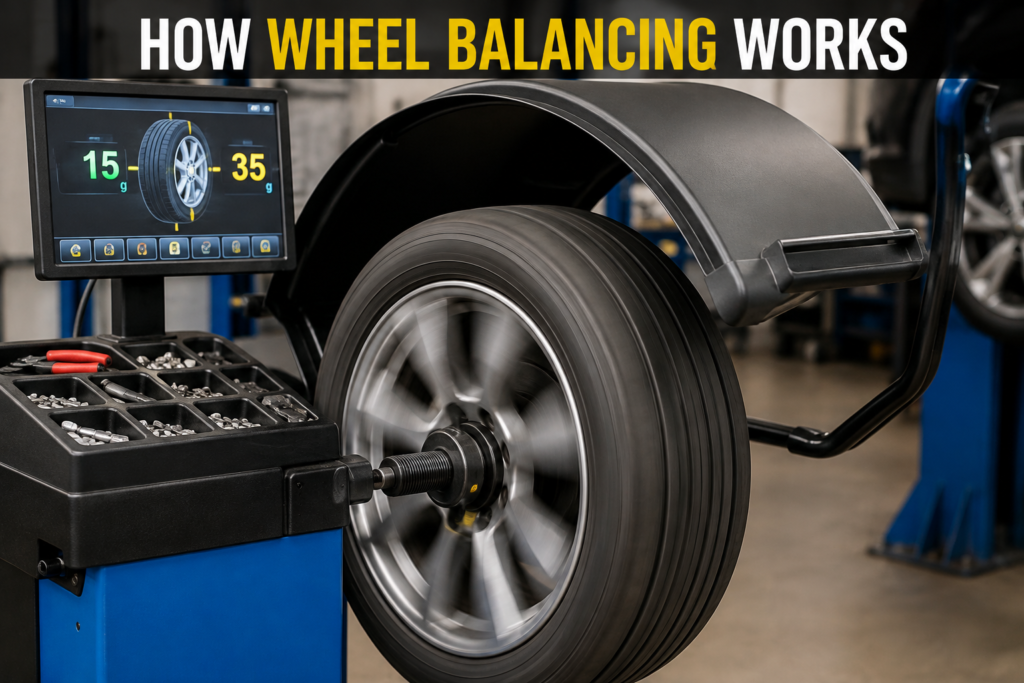
A mechanic uses a wheel balancing machine to identify where the imbalance is located. The machine spins the wheel and measures the amount of imbalance. It then tells the technician where to place small wheel weights to correct the problem.
The main purpose of wheel balancing is to make sure the wheel rotates as evenly as possible.
How Does Wheel Balancing Work?
The basic idea behind wheel balancing is actually quite simple. Imagine spinning a wheel with a small amount of extra weight attached to one side. As the wheel rotates, that heavier section creates an uneven force.
The faster the wheel spins, the more noticeable that force becomes. A vehicle wheel can rotate extremely quickly while driving, so even a small imbalance can produce vibration.
During wheel balancing, the tire and wheel are mounted onto a specialized balancing machine. The machine spins the assembly and uses sensors to detect the location and amount of imbalance.
The technician then adds a small amount of weight to specific areas of the wheel. These weights counteract the heavier areas and help create a more even distribution of weight.
After the weights are installed, the wheel is spun again. If the machine shows that the wheel is properly balanced, the process is complete.
What Happens During a Wheel Balancing Service?
When I take a vehicle for wheel balancing, I expect the technician to inspect more than just the wheel weight. A proper service normally starts with checking the tire and wheel for obvious problems.
The wheel is removed from the vehicle and mounted securely on the balancing machine. The technician makes sure the wheel is positioned correctly because incorrect mounting can affect the accuracy of the results.
The machine then spins the wheel at a controlled speed. Sensors measure the forces created as the wheel rotates. Modern machines can identify both the amount of weight needed and the exact location where the weight should be installed.
The technician installs the recommended wheel weights and runs the wheel again.
If the machine shows that the wheel is balanced, it can be installed back onto the vehicle.
This process may seem simple, but accuracy matters. A poorly balanced wheel can continue to cause vibration even after weights have been installed.
Why Are Wheel Weights Used?
Wheel weights are small pieces of material designed to correct an imbalance in a wheel and tire assembly. They come in different sizes and styles depending on the wheel and the balancing method being used.
Some weights attach to the edge of a wheel, while others are attached to the inside surface. The choice depends on the type of wheel and the manufacturer’s requirements.
The purpose is not to add a large amount of weight. Instead, the technician adds just enough weight to compensate for the imbalance detected by the balancing machine.
For example, if one part of the wheel assembly is slightly heavier than another, the technician can place a small weight on the opposite side. This helps distribute the overall weight more evenly.
Signs Your Wheels May Need Balancing
One of the most common signs of wheel imbalance is vibration. You may feel this vibration through the steering wheel, seats, or floor of the vehicle.
The exact location of the vibration can sometimes provide useful information. For example, vibration through the steering wheel may be related to the front wheels, although other suspension and steering problems can cause similar symptoms.
Another common sign is vibration that becomes more noticeable at higher speeds. You might drive around town without noticing anything unusual, but once you reach highway speeds, the vehicle may start feeling less smooth.
Uneven tire wear can also occur when there is an ongoing wheel or tire problem. However, uneven wear can have many causes, including incorrect tire pressure, wheel alignment issues, suspension problems, and poor tire condition.
If you notice unusual vibration, it is better to have the wheels and tires inspected instead of assuming that balancing is the only possible cause.
Wheel Balancing vs Wheel Alignment
Wheel balancing and wheel alignment are two different services, although they are often confused.
Wheel balancing focuses on the distribution of weight around the tire and wheel assembly. The goal is to make the wheel rotate smoothly.
Wheel alignment focuses on the angles of the wheels in relation to the vehicle and the road. Alignment affects how the vehicle tracks, how the steering feels, and how the tires make contact with the road.
A vehicle can have properly aligned wheels that still need balancing. It can also have balanced wheels that require an alignment.
In my view, understanding this difference can save drivers a lot of confusion. If the vehicle is pulling to one side, alignment may be worth checking. If you are experiencing vibration at certain speeds, wheel balancing is one of the first things worth inspecting.
When Should You Get Wheel Balancing?
There is not always a fixed mileage interval for wheel balancing. It is commonly performed when new tires are installed, when a tire is repaired or removed from the wheel, or when vibration develops.
Wheel balancing can also be useful after hitting a pothole or curb. A strong impact can damage a tire, bend a wheel, or cause a wheel weight to come off.
If you regularly drive on rough roads, it is especially important to pay attention to changes in how your vehicle feels.
I would not recommend waiting for severe vibration before checking the wheels. Small problems can become more noticeable over time, and early inspection may help prevent additional tire wear or discomfort.
Can Wheel Imbalance Damage Tires?
A wheel imbalance can contribute to irregular tire wear because the tire does not rotate as smoothly as it should. The constant vibration can place additional stress on the tire, wheel, and related components.
This does not mean every unbalanced wheel will immediately damage a tire. However, ignoring a noticeable vibration for a long time is not a good idea.
Tires are an important part of vehicle safety, so maintaining them properly is always worthwhile. Correct tire pressure, regular inspections, proper alignment, and wheel balancing can all contribute to better tire performance.
What Causes Wheel Imbalance?
There are several reasons why a wheel and tire assembly can become unbalanced.
One common reason is simply the natural difference in weight between different parts of the tire and wheel. Manufacturing is precise, but it does not mean every part has exactly the same weight.
A wheel weight can also fall off while driving. This can happen after hitting a pothole, cleaning the wheel, or through normal use.
A tire can also develop a problem that changes its shape or weight distribution. Damage to the wheel can create another issue. A bent wheel may not rotate correctly even if balancing weights are installed.
Mud, dirt, or other material stuck inside the wheel can also affect balance. This is one reason why cleaning wheels can sometimes be more important than people realize.
How Long Does Wheel Balancing Take?
Wheel balancing is generally a relatively quick service. The actual time depends on the vehicle, the number of wheels being checked, the condition of the tires, and the equipment being used.
If the technician finds additional problems, such as a damaged tire or bent wheel, the inspection may take longer.
The important thing is not to rush the process. Proper mounting and accurate measurements are more important than simply completing the service quickly.
Does Wheel Balancing Improve Driving Comfort?
Yes, proper wheel balancing can make a noticeable difference in driving comfort when an imbalance was causing vibration.
A balanced wheel rotates more smoothly, which can make the vehicle feel more stable and comfortable. The improvement can be especially noticeable at higher speeds.
I personally think wheel balancing is one of those maintenance services that drivers appreciate most when they experience the difference themselves. A vehicle that previously felt rough or shaky can feel much smoother after the underlying wheel imbalance is corrected.
Final Thoughts
Wheel balancing works by correcting differences in weight around the tire and wheel assembly. A balancing machine spins the wheel, detects the imbalance, and tells the technician where and how much weight should be added.
Although the process is straightforward, it plays an important role in vehicle comfort, tire performance, and smooth driving.
If you notice steering wheel vibration, unusual vibration at higher speeds, or irregular tire wear, it is worth having your wheels and tires inspected. Wheel balancing may be a simple solution, but it should not be confused with wheel alignment or other suspension repairs.
From my point of view, regular tire and wheel maintenance is one of the easiest ways to keep a vehicle feeling good on the road. Paying attention to small changes in vibration and handling can help you identify problems before they become more expensive.
A properly balanced wheel may not be something you notice every day, but you can certainly notice when a wheel is not balanced properly. That is why understanding how wheel balancing works can help every driver make better decisions about vehicle maintenance.
Featured image: The generated wheel balancing image above is suitable as a WordPress featured image and is designed as a clean, general automotive educational visual without placing the blog article text on the image.