Related Articles

When it comes to basic car maintenance, changing the engine oil is one of the most important things I always pay attention to. Engine oil may look like a simple fluid, but it plays a major role in keeping the engine running smoothly. It lubricates moving parts, helps control heat, reduces friction, and carries away small particles that can build up inside the engine.
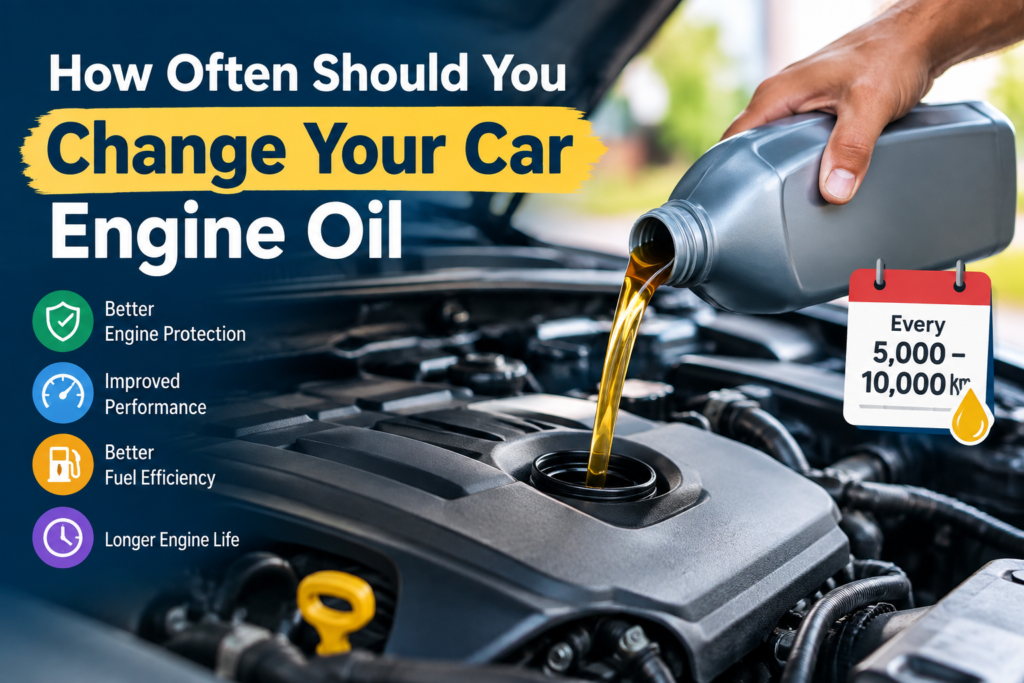
One question many car owners ask is, how often should you change your car engine oil? The answer is not exactly the same for every vehicle. It depends on the type of oil, the vehicle, driving conditions, engine age, and the recommendation from the manufacturer.
In my experience, following a regular car oil change schedule is much better than waiting until there is an obvious engine problem. A small maintenance task can help prevent much more expensive repairs later.
How Often Should You Change Engine Oil?
For many modern vehicles, an oil change may be needed somewhere around 5,000 to 10,000 miles, depending on the vehicle and oil being used. Some modern cars can go longer because they use advanced synthetic oils and have engines designed for longer service intervals.
However, I would never choose an oil change interval based only on a general number. The owner’s manual is usually the best place to start because the manufacturer provides a recommended maintenance schedule for that specific vehicle.
If your manufacturer recommends changing the oil every 7,500 miles, for example, I would follow that recommendation instead of automatically changing it every 3,000 miles.
The important thing is to understand that oil change frequency depends on several factors.
Why Does Engine Oil Need to Be Changed?
Engine oil works inside a very hot and demanding environment. As the engine runs, the oil moves through many components and protects them from excessive friction.
Over time, engine oil can become contaminated with dirt, tiny metal particles, combustion byproducts, and other materials. The oil can also lose some of its ability to protect the engine.
When old oil stays in the engine for too long, it may not provide the same level of lubrication as fresh oil.
I think of engine oil as one of the basic protective layers between expensive engine components. Keeping that protection fresh is a simple way to support engine health.
Does Synthetic Oil Last Longer?
Yes, synthetic oil is generally designed to provide strong performance and stability over longer intervals than conventional oil. Many modern vehicles require or recommend synthetic oil.
However, using synthetic oil does not mean you can ignore the manufacturer’s recommended maintenance schedule.
Some drivers assume that synthetic oil automatically means they can double the oil change interval. I would not recommend making that decision without checking the owner’s manual.
The correct synthetic oil change interval depends on the vehicle, engine, oil specification, and driving conditions.
How Driving Conditions Affect Oil Change Frequency
Your driving habits can make a significant difference.
If you mostly drive on highways for long distances, your engine may operate under relatively consistent conditions. This can be easier on the oil compared with constant short trips.
Short trips can be harder on an engine because the engine may not stay at its ideal operating temperature for long enough. Frequent starting and stopping can also increase the demands placed on the oil.
Heavy traffic is another factor. Sitting in traffic with the engine running for long periods can contribute to severe driving conditions.
Other conditions that may require more frequent maintenance include very hot or very cold weather, dusty roads, towing heavy loads, and frequent stop and go driving.
If your driving falls into these categories, checking the manufacturer’s severe service recommendations is a smart idea.
Should You Change Oil Based on Time or Mileage?
I believe you should consider both time and mileage.
For example, if you do not drive your car very often, you might think you can simply wait until you reach the recommended mileage. That is not always the best approach.
Oil can age even when the vehicle is not driven frequently. Moisture and other contaminants can also become a concern, particularly when a vehicle is used mainly for very short trips.
Many manufacturers provide both a mileage interval and a time interval. Following whichever requirement comes first is generally a sensible approach.
Always check your vehicle’s maintenance schedule because the exact recommendation can vary.
Signs That Your Car May Need an Oil Change
Although I prefer following a maintenance schedule instead of waiting for warning signs, your vehicle can sometimes provide clues that the oil needs attention.
One possible sign is unusually dark or dirty oil. However, oil naturally becomes darker as it does its job, so color alone does not always mean an oil change is immediately necessary.
Another sign can be an oil warning light on the dashboard. If an oil pressure warning light comes on, I would take it seriously rather than assuming the car simply needs an oil change.
Unusual engine noise can also deserve attention. Since engine components depend on proper lubrication, changes in engine sound should not be ignored.
You might also notice an oil smell, visible oil leakage, or a noticeable drop in oil level.
These signs do not necessarily mean that an oil change is the only solution. They can indicate a larger problem, so having the vehicle inspected is important.
Why Is the Oil Filter Important?
When discussing how often to change car engine oil, it is easy to forget about the oil filter.
The oil filter removes contaminants from the oil as it circulates through the engine. If the filter becomes heavily contaminated, it may not perform as effectively as a clean filter.
That is why I consider replacing the oil filter during an oil change an important part of routine maintenance.
A fresh oil filter combined with the correct engine oil gives the engine a clean starting point for the next maintenance interval.
What Happens If You Do Not Change Engine Oil?
Delaying an oil change once may not immediately destroy an engine, but regularly ignoring oil changes can create serious problems.
Old or degraded oil may provide less effective lubrication. Increased friction can contribute to wear on internal engine components.
Over a long period, poor oil maintenance can contribute to sludge formation and other engine problems.
Engine repairs can be extremely expensive compared with routine oil maintenance. That is one reason I see an oil change as an investment rather than an unnecessary expense.
A few minutes of planning and a reasonable maintenance cost can help protect one of the most expensive parts of your vehicle.
How Can You Check Your Engine Oil?
Checking the oil level is a simple habit that many drivers can learn.
First, park the vehicle on a level surface and follow the manufacturer’s instructions for checking the oil. Some vehicles should be checked when the engine is cold, while others have specific procedures.
If your vehicle has a traditional dipstick, remove it, wipe it clean, insert it again, and then remove it to check the oil level.
The oil should generally be between the minimum and maximum marks.
Do not add too much oil. Overfilling can also cause problems.
If the oil level is repeatedly dropping, I would not simply keep adding oil without investigating the reason. The vehicle could have a leak or be consuming oil.
How Much Does an Oil Change Cost?
The cost of an oil change depends on several factors, including the vehicle, oil type, engine size, filter, and where the service is performed.
Conventional oil can sometimes cost less than synthetic oil, while some high performance or specialty vehicles require more expensive oil.
I would not choose the cheapest possible option without checking whether the oil meets the specifications required for the engine.
Using the correct oil specification is more important than simply choosing an oil because it is inexpensive.
Should You Change Oil More Frequently?
Changing oil more frequently than the manufacturer recommends is not always necessary.
If your vehicle has a modern engine and you use the correct oil, following the recommended interval is usually a practical approach.
However, if you frequently drive in severe conditions, your manufacturer’s maintenance schedule may recommend shorter intervals.
I also think older vehicles deserve closer attention. An older engine may consume oil or develop leaks, making regular oil level checks particularly important.
The best approach is to understand how your car is used instead of following one universal rule.
My Simple Oil Change Routine
If I were creating a simple routine for a car owner, I would start by checking the owner’s manual. I would find the recommended oil type and maintenance interval.
Then I would keep a record of every oil change. Writing down the date and mileage makes it much easier to know when the next service is approaching.
I would also check the oil level regularly, especially before longer journeys.
Finally, I would pay attention to dashboard warning lights, leaks, unusual engine sounds, and changes in vehicle performance.
These simple habits can make car engine maintenance much easier.
Final Thoughts
So, how often should you change your car engine oil? There is no single interval that is perfect for every car. Many vehicles fall somewhere around 5,000 to 10,000 miles between oil changes, but the correct interval depends on the manufacturer’s recommendation, oil type, driving conditions, and vehicle age.
For me, the most important lesson is not to guess. Check the owner’s manual, use the correct engine oil, replace the oil filter when appropriate, and keep track of your maintenance.
Regular engine oil changes are one of the simplest ways to support a healthy engine. Taking care of this basic maintenance can help your vehicle run smoothly and may reduce the chance of expensive engine problems in the future.