
Related Articles


A car battery is one of those parts that we often ignore until the car refuses to start. In my experience, a little attention to the battery can save a lot of trouble, especially when you depend on your car every day. The good thing is that you do not always need to visit a mechanic to check your car battery. With a few simple tools and some basic knowledge, you can perform a useful car battery check at home.
Checking your car battery at home can help you understand its condition, identify signs of corrosion, check the battery voltage, and notice possible starting problems before they become serious. In this guide, I will explain how to check your car battery at home in a simple and practical way.
Why You Should Check Your Car Battery
I believe regular battery checks are an important part of basic car maintenance. A weak battery can cause slow engine cranking, dim headlights, electrical problems, or a complete no start situation.
Car batteries do not usually give you a convenient warning that they are about to fail. Sometimes they work normally one day and struggle to start the car the next morning. This is why checking the battery from time to time is useful.
A battery inspection is especially important before a long road trip, after the car has been sitting unused for a long period, or when you notice that the engine takes longer than usual to start.
What You Need to Check a Car Battery at Home
You can perform a basic visual inspection without special equipment. However, if you want to check the battery voltage, a digital multimeter is very useful.
For a basic car battery check, I recommend having a digital multimeter, safety gloves, safety glasses, and a clean cloth. If you notice corrosion around the terminals, you may also need appropriate battery terminal cleaning materials.
Before starting, park the car on a level surface, switch off the engine, remove the key, and make sure the vehicle is secure.
Start With a Visual Battery Inspection
The first step is a simple visual inspection. Open the hood and locate the car battery. Look carefully at the battery case and the surrounding area.
Check whether the battery case appears swollen, cracked, leaking, or damaged. A damaged battery should not be handled casually because battery fluid can be harmful.
Next, look at the battery terminals. They should be reasonably clean and firmly connected. White, blue, or greenish buildup around the terminals can indicate corrosion.
Also check the cables connected to the battery. They should not appear badly damaged, loose, or excessively worn.
A clean and secure battery connection is important because poor connections can create starting problems even when the battery itself is still in reasonable condition.
Check the Battery Terminals
Battery terminals are the connection points between the battery and the vehicle’s electrical system. If they become dirty or corroded, electricity may not flow properly.
I always recommend looking closely at both the positive and negative terminals. Make sure the connections are secure and that there is no heavy corrosion.
Do not touch the terminals unnecessarily while inspecting them. If cleaning is required, follow your vehicle and battery manufacturer’s instructions and use suitable protective equipment.
If the corrosion is severe or the terminal is badly damaged, getting professional help is the safer option.
How to Check Car Battery Voltage With a Multimeter
One of the most useful ways to check a car battery at home is to measure its voltage with a digital multimeter.
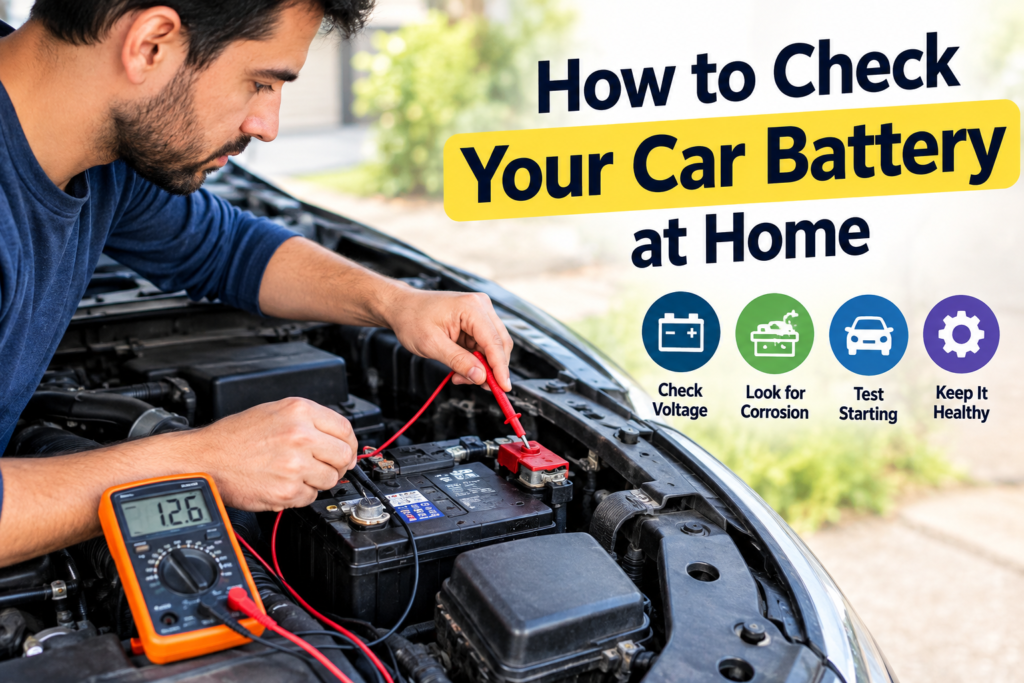
First, make sure the engine is switched off and has been off for a while. Set the multimeter to DC voltage. For a typical 12 volt automotive battery, select a voltage range that can measure around 12 volts.
Connect the red probe to the positive battery terminal and the black probe to the negative terminal. Make sure the probes are making proper contact.
A fully charged healthy 12 volt battery will commonly show around 12.6 volts when the engine is off and the battery has rested. A reading around 12.4 volts indicates a lower state of charge, while a reading around 12.2 volts is significantly lower.
These numbers are useful as general guidance rather than an absolute diagnosis. Battery type, temperature, recent driving, and the vehicle’s electrical system can affect the reading.
If your battery consistently shows a low voltage after being properly charged, it may need further testing.
Check the Battery While the Engine Is Running
You can also use a multimeter to get an idea of whether the vehicle’s charging system is working.
Start the engine and carefully measure the battery voltage again. In many conventional vehicles, the voltage should rise above the resting battery voltage when the engine is running because the alternator is charging the electrical system.
A common charging voltage range is roughly 13.7 to 14.7 volts, although the correct range depends on the vehicle and charging system.
Modern vehicles can use smart charging systems, so the voltage may vary considerably. Because of this, I would not diagnose an alternator problem from one voltage reading alone.
If the voltage remains unusually low while the engine is running, it is worth having the charging system professionally inspected.
Listen to How Your Car Starts
Another simple way to check your car battery is to pay attention when starting the engine.
A healthy battery usually allows the starter motor to turn the engine over quickly and consistently. If you hear slow cranking, repeated clicking, or the engine struggles before starting, the battery could be weak.
However, starting problems do not always mean the battery is the problem. A poor electrical connection, starter motor issue, charging problem, or another mechanical fault can create similar symptoms.
This is why I prefer combining the starting symptoms with a visual inspection and voltage test rather than relying on one sign.
Check for Battery Corrosion
Corrosion is one of the most common things you may notice during a home battery inspection.
A small amount of buildup around the terminals should not automatically mean the battery is failing. However, heavy corrosion deserves attention because it can interfere with the electrical connection.
If you find corrosion, do not simply ignore it. Follow the battery manufacturer’s cleaning instructions or ask a qualified technician to clean and inspect the terminals.
It is also important to understand why corrosion is appearing. Repeated corrosion may be connected to battery condition, terminal connections, or other issues that deserve professional inspection.
Check the Battery Age
Battery age is another important factor. Most automotive batteries have a limited service life, although the actual lifespan depends on climate, driving habits, vehicle use, battery quality, and maintenance.
Look for a date code or label on the battery. If the battery is several years old and you are already experiencing slow starts, it may be worth testing it professionally.
I personally think knowing the battery’s age is just as useful as checking its voltage. A battery can show a reasonable voltage but still have reduced starting performance.
Signs Your Car Battery May Be Weak
There are several warning signs that can suggest your battery needs attention.
The engine may crank more slowly than normal. You may notice dim headlights before starting the engine. Electrical accessories may behave strangely, or the car may need a jump start more than once.
Another sign is repeated difficulty starting the vehicle after it has been parked overnight.
If your car repeatedly loses battery power, do not immediately assume that you only need a new battery. There could be a parasitic electrical drain, alternator problem, poor connection, or another issue causing the battery to discharge.
When You Should Get Professional Battery Testing
A home battery check is useful, but it cannot replace every type of professional battery test.
If the battery case is swollen, cracked, leaking, or seriously damaged, avoid handling it unnecessarily and seek professional assistance.
You should also consider professional testing if your battery voltage appears normal but the vehicle continues to have starting problems.
A mechanic can perform a more detailed battery test under load and can also inspect the alternator, starter, cables, and charging system.
This is particularly important before a long journey because discovering a weak battery at home is much better than discovering it in an unfamiliar location.
How Often Should You Check Your Car Battery?
There is no single schedule that works perfectly for every vehicle, but checking the battery every few months is a sensible habit for many drivers.
I would pay extra attention before winter or periods of extreme weather, before long trips, and whenever the vehicle has been unused for an extended period.
If you notice any change in starting performance, do not wait for your normal maintenance schedule. Check the battery sooner.
Simple Tips to Keep Your Car Battery Healthy
Keeping your battery healthy starts with good basic maintenance. Make sure the terminals remain clean and the connections are secure.
Avoid leaving headlights, interior lights, or accessories switched on when the engine is off.
If your car is parked for long periods, remember that modern vehicles can continue using a small amount of electrical power even when the engine is not running.
Regular driving can help maintain the battery charge, although it is not always enough to recover a deeply discharged battery.
If your vehicle has specific battery maintenance requirements, always follow the owner’s manual.
Final Thoughts
Learning how to check your car battery at home is a simple skill that can make everyday car ownership easier. You do not need to be an expert mechanic to perform a basic visual inspection, look for corrosion, listen for starting problems, and measure battery voltage with a digital multimeter.
In my opinion, the most important thing is not to depend on a single test. Look at the battery’s condition, age, voltage, connections, and starting performance together. If something does not look right, getting professional advice can prevent a small battery problem from becoming a bigger inconvenience.
A few minutes spent checking your car battery at home can give you useful information about your vehicle and may help you avoid an unexpected no start situation. Good car maintenance is often about noticing small problems before they turn into expensive or stressful ones.