
Related Articles

When I talk about tire maintenance, one thing I believe many drivers overlook is tire rotation. Most people know that tires need regular rotation, but not everyone understands that there are different tire rotation patterns. The correct pattern depends on your vehicle, tire type, drivetrain, and whether the tires are directional or non directional.
In my experience, understanding tire rotation patterns makes tire maintenance much easier. A proper rotation can help your tires wear more evenly, improve handling, and potentially extend their usable life. It can also help you notice tire problems before they become serious.
In this guide, I will explain the most common tire rotation patterns, when each one is used, and what you should know before rotating your tires.
Why Tire Rotation Is Important
Before discussing the different patterns, it is worth understanding why tire rotation matters.
Your tires do not wear evenly because each wheel position has a different job. On many vehicles, the front tires handle steering and a large portion of braking forces. On front wheel drive vehicles, they also handle the engine power sent to the road. Because of this, front tires can wear faster than rear tires.
If you never rotate your tires, one pair may become significantly more worn than the other pair. This can affect traction, braking performance, road noise, and driving comfort.
Regular tire rotation helps distribute this wear more evenly. Instead of allowing two tires to wear out much earlier, rotation gives all four tires a better opportunity to wear at a similar rate.
I personally see tire rotation as one of the simplest maintenance tasks that can help protect an investment in good tires.
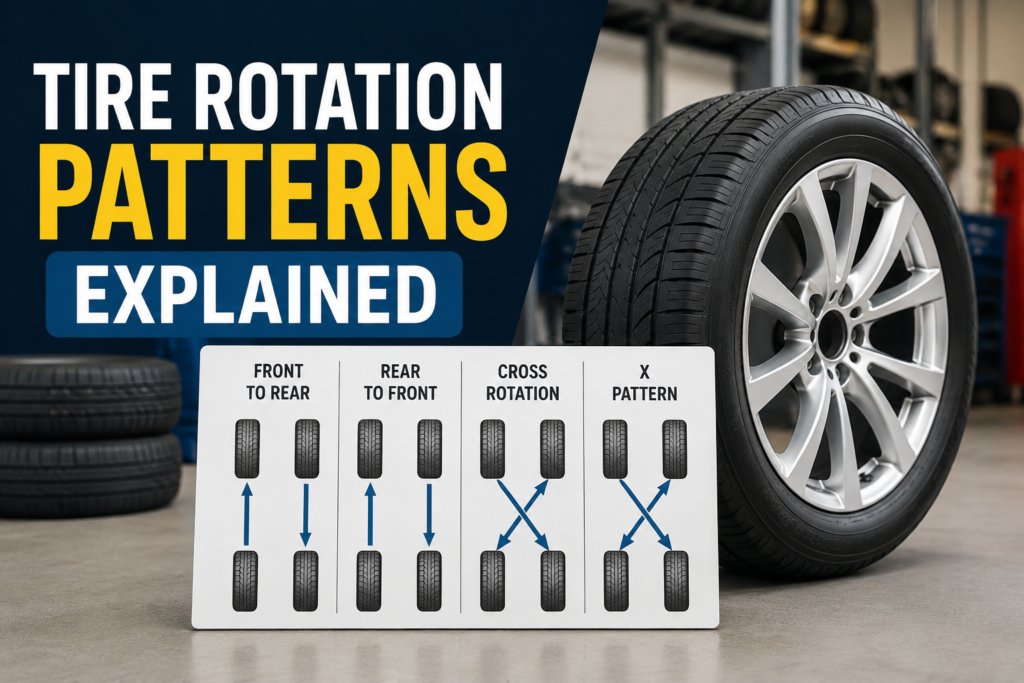
The Forward Cross Tire Rotation Pattern
The forward cross is one of the common tire rotation patterns used on certain vehicles, especially front wheel drive vehicles with non directional tires.
With this pattern, the front tires move straight to the rear. The rear tires then cross to the opposite sides at the front.
For example, the left front tire moves to the left rear. The right front tire moves to the right rear. The left rear tire moves to the right front, while the right rear tire moves to the left front.
This pattern can help distribute the heavier workload experienced by front tires.
However, this pattern should only be used when the tire and vehicle manufacturer allow it. You should always check your vehicle owner’s manual before deciding which rotation pattern is appropriate.
The Rearward Cross Tire Rotation Pattern
The rearward cross pattern works in the opposite direction.
The rear tires move straight forward to the front positions. The front tires then cross to the opposite rear positions.
This pattern is commonly associated with rear wheel drive and four wheel drive vehicles using suitable non directional tires.
For example, the left rear tire moves to the left front position, while the right rear tire moves to the right front. The front tires then move diagonally to the opposite rear positions.
The idea is to distribute tire wear between different positions on the vehicle.
The X Pattern
The X pattern is another tire rotation method that can be used with certain vehicles and non directional tires.
In an X rotation, the tires move diagonally from one corner of the vehicle to another. The left front tire can move to the right rear, while the right front tire can move to the left rear. The rear tires move diagonally toward the front.
This pattern can be useful for vehicles where the manufacturer allows cross rotation.
I would not recommend choosing the X pattern simply because it looks convenient. The correct tire rotation pattern should always be based on your vehicle and tire specifications.
The Side To Side Pattern
The side to side pattern is different from the patterns that move tires between the front and rear axles.
In this method, tires are moved from one side of the vehicle to the other while staying on the same axle.
For example, the left front tire can move to the right front position, and the right front tire can move to the left front position.
This method is often used when a vehicle has different tire sizes on the front and rear axles. It may also be suitable for certain directional tire setups, depending on the manufacturer’s instructions.
Because the tires remain on the same axle, this pattern does not provide the same front to rear movement as other rotation methods.
Tire Rotation for Directional Tires
Directional tires require extra attention.
A directional tire is designed to rotate in one specific direction. The tread pattern is designed to perform properly when the tire travels in that direction.
Because of this, directional tires generally cannot simply be crossed from one side of the vehicle to the other. Doing so could cause the tire to rotate against its intended direction.
For many directional tire setups, the appropriate method is to move the front tire to the rear on the same side and the rear tire to the front on the same side.
If you have directional tires, look for the rotation arrow on the sidewall. This arrow shows the intended direction of rotation.
I always recommend checking this before any tire rotation because installing a directional tire incorrectly can create a serious safety concern.
Staggered Tire Rotation
Some performance vehicles use staggered tire sizes. This means the front and rear tires are different sizes.
For example, the vehicle may have narrower tires on the front and wider tires on the rear.
With a staggered setup, normal front to rear tire rotation may not be possible because the tire sizes do not match.
In some cases, the tires may be rotated from side to side if the design allows it. However, some staggered setups do not allow any rotation at all.
This is why checking your vehicle owner’s manual is especially important when you have performance wheels or different tire sizes.
Can You Rotate Directional and Staggered Tires?
This is a question I often see when people start learning about tire rotation patterns.
The answer depends on the exact tire and wheel setup.
Directional tires can usually be rotated front to rear on the same side, provided the tire size and vehicle specifications allow it.
Staggered tires may only allow side to side movement, and some cannot be rotated.
If your front and rear tires have different sizes, do not assume that a standard rotation pattern will work. The information printed on the tire sidewall and the instructions from the vehicle manufacturer should take priority.
How Often Should You Rotate Your Tires?
A common recommendation is to rotate tires roughly every 5,000 to 8,000 miles, although the correct interval can vary.
Some vehicle manufacturers provide a specific tire rotation schedule in the owner’s manual. Your tire manufacturer may also provide recommendations.
I prefer to think of tire rotation as something that should become part of routine maintenance rather than something to remember only when the tires look worn.
If you change your engine oil regularly, checking whether your tires are due for rotation at the same time can make the maintenance routine easier to remember.
Driving conditions also matter. Frequent city driving, hard braking, heavy loads, rough roads, and aggressive acceleration can contribute to faster or uneven tire wear.
Signs That Your Tires Need Attention
Even if you follow a regular tire rotation schedule, you should inspect your tires between rotations.
Look for uneven tread wear, excessive wear on one side, unusual vibrations, steering changes, or increased road noise.
If one tire looks significantly different from the others, do not simply rotate it and forget about the problem. Uneven wear can sometimes indicate incorrect tire pressure, poor wheel alignment, suspension problems, or another mechanical issue.
For example, if the inside edge of a tire is wearing much faster than the rest of the tread, rotation alone may not solve the problem.
This is one reason I believe tire rotation should be treated as an inspection opportunity as well as a maintenance task.
Tire Pressure Still Matters
Tire rotation cannot compensate for incorrect tire pressure.
Underinflated or overinflated tires can wear differently and may affect handling and fuel economy.
I recommend checking tire pressure regularly, especially before long trips. Use the recommended pressure listed by the vehicle manufacturer rather than simply copying the maximum pressure printed on the tire sidewall.
Keeping pressure at the correct level helps your tires maintain proper contact with the road and can support more even tread wear.
What Happens If You Never Rotate Your Tires?
Skipping tire rotation does not necessarily mean your tires will fail immediately. However, uneven wear can develop over time.
On many front wheel drive vehicles, the front tires can wear considerably faster than the rear tires. If you continue driving without rotating them, you may eventually need to replace the front tires while the rear tires still have useful tread.
Replacing only two tires can also create considerations regarding traction balance, especially in wet conditions. Depending on the vehicle and tire manufacturer recommendations, new tires are often placed on the rear axle when replacing only two tires.
Regular rotation can help reduce the chance of having such a large difference in tread depth between the tires.
The Best Tire Rotation Pattern Depends on Your Vehicle
There is no single best tire rotation pattern for every vehicle.
The forward cross, rearward cross, X pattern, and side to side methods all have specific applications.
Your drivetrain also matters. Front wheel drive, rear wheel drive, and four wheel drive vehicles can experience different wear patterns.
Your tire design matters too. Directional tires and staggered tire setups require special consideration.
For that reason, I would always start with the vehicle owner’s manual. Then check the tire manufacturer’s instructions if necessary.
Final Thoughts
Understanding tire rotation patterns is a simple way to become more informed about vehicle maintenance. Tire rotation is not just about moving tires from one position to another. The pattern needs to match the tire design and vehicle setup.
The forward cross pattern, rearward cross pattern, X pattern, and side to side pattern can all be useful in the right situation. Directional and staggered tires require additional care because they may limit how the tires can be moved.
From my point of view, the most important thing is consistency. Check your tire pressure, inspect the tread, watch for unusual wear, and rotate your tires according to the manufacturer’s recommended schedule.
A few minutes of attention during routine maintenance can help you get more consistent wear from your tires and maintain better driving performance. Most importantly, never guess when it comes to tire rotation. If you are unsure which pattern applies to your vehicle, check the owner’s manual or ask a qualified tire professional.
Good tire maintenance is a small part of vehicle ownership, but it can make a meaningful difference in safety, comfort, and the overall life of your tires.