Related Articles
Checking tire pressure is one of the simplest things I can do to take better care of my car. It does not require advanced mechanical knowledge, expensive equipment, or a lot of time. Still, many drivers ignore tire pressure until they notice a warning light, uneven tire wear, or a change in the way the car feels on the road.
In my experience, checking tire pressure regularly is a small habit that can make a noticeable difference. Correct tire pressure can help improve driving safety, handling, fuel efficiency, and tire life. The important thing is knowing how to check tire pressure correctly and understanding which pressure number you should actually use.
In this guide, I will explain how to check tire pressure the right way, what tools you need, when to check it, and what to do if the pressure is too high or too low.
Why Checking Tire Pressure Is Important
Tires are the only parts of the car that directly touch the road, so their condition matters a lot. Tire pressure affects how the vehicle handles, stops, and responds to steering.
When tire pressure is too low, more of the tire touches the road. This can create additional rolling resistance and may cause the tire to wear faster. It can also affect handling and fuel economy.
When tire pressure is too high, the tire can become harder and may provide less comfortable handling over rough roads. It can also affect the way the tire contacts the road.
That is why I believe maintaining the recommended tire pressure is better than simply putting air in whenever the tires look low.
What Tire Pressure Should You Use?
One of the most common mistakes is assuming that the number written on the tire sidewall is the recommended pressure for everyday driving.
The correct tire pressure is normally listed on the vehicle information label. You can usually find this label inside the driver’s door area, on the door frame, or in the vehicle owner’s manual.
The label may show the recommended pressure for the front and rear tires. Some vehicles can have different recommendations depending on the load or driving conditions.
The pressure is commonly measured in PSI, which means pounds per square inch.
Before checking your tires, I recommend finding the manufacturer’s recommended tire pressure first. This gives you the correct number to compare with your gauge reading.
What You Need to Check Tire Pressure
You do not need many tools to check tire pressure. The main tool is a reliable tire pressure gauge.
There are several types of tire pressure gauges available. A basic mechanical gauge is inexpensive and simple to use. Digital tire pressure gauges are also popular because they provide an easy to read number.
You may also need an air compressor if the tire pressure needs to be increased. Many fuel stations have air pumps, and you can also keep a small portable compressor in your vehicle.
Personally, I think keeping a tire pressure gauge in the car is a useful idea. It allows me to check the tires whenever necessary instead of depending completely on a service station.
Check Tire Pressure When the Tires Are Cold
One of the most important things to remember is that tire pressure should ideally be checked when the tires are cold.
Driving causes the tires to heat up. As the temperature of the tire increases, the air pressure inside it can also increase. If I check the pressure immediately after a long drive, the reading may be higher than the normal cold tire pressure.
For the most accurate reading, check the tires before driving or after the vehicle has been parked for several hours.
This is especially important when you are trying to adjust tire pressure to the manufacturer’s recommended specification.
Step One: Park on a Level Surface
Start by parking the car on a reasonably level surface. Make sure the vehicle is safely parked and the engine is off.
If possible, check the tire pressure before driving. If the car has already been driven, allow the tires enough time to cool down.
I also like to visually inspect each tire before using the pressure gauge. Look for obvious damage, nails, cuts, cracks, or anything unusual.
Step Two: Remove the Valve Cap
Each tire has a small valve stem where you add or remove air. The valve usually has a protective cap.
Unscrew the cap carefully and place it somewhere safe. Losing a valve cap is easy, especially when checking all four tires, so I recommend putting each cap somewhere where it will not roll away.
The valve cap helps keep dirt and moisture away from the valve, so it is important to replace it after checking the pressure.
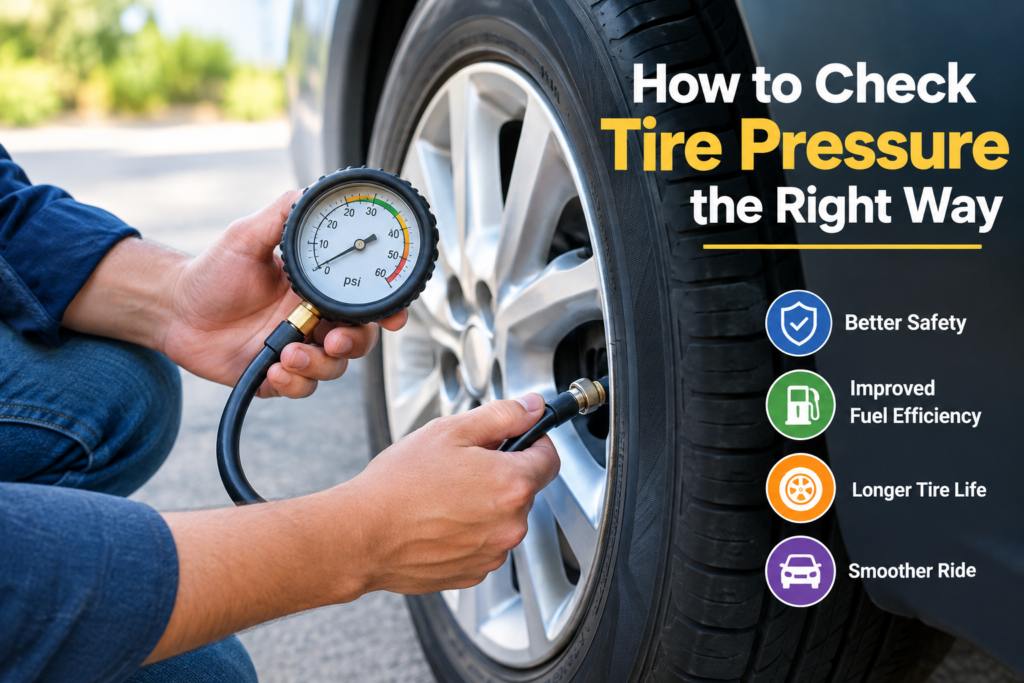
Step Three: Attach the Tire Pressure Gauge
Press the tire pressure gauge firmly against the valve stem.
You should hear a short hiss of air when the gauge is connected. A small amount of air escaping while you attach the gauge is normal, but try to create a proper seal so the reading is accurate.
Hold the gauge steady until the pressure reading becomes stable.
If you are using a digital tire pressure gauge, the number should appear on the screen. With a traditional gauge, you will read the measurement from the scale.
Step Four: Compare the Reading
Now compare the tire pressure reading with the recommended pressure listed by the vehicle manufacturer.
For example, if your vehicle recommends 35 PSI and your gauge shows 30 PSI, the tire needs more air.
If the gauge shows a significantly higher number than recommended, some air may need to be released.
Do not guess the correct pressure. Always use the vehicle manufacturer’s recommended specification.
Step Five: Add Air if Necessary
If the tire pressure is below the recommended level, connect an air compressor to the valve.
Add air gradually rather than filling the tire for a long time without checking the pressure.
I prefer checking the pressure again after adding air because air compressors and gauges can vary in accuracy. Adding a little air, checking the pressure, and repeating the process gives me better control.
Once the tire reaches the recommended pressure, remove the air hose and check the pressure again with your tire pressure gauge.
Step Six: Release Air if the Pressure Is Too High
If the tire has too much air, you need to reduce the pressure carefully.
Many tire valves allow you to release a small amount of air by pressing the valve core. Some air pumps also have controls that make this easier.
Release only a little air at a time and check the pressure again.
It is much easier to remove a small amount of air than to accidentally release too much and then have to refill the tire.
Step Seven: Replace the Valve Cap
After checking and adjusting the tire pressure, put the valve cap back onto the valve stem.
Make sure it is screwed on properly but do not overtighten it.
Repeat the same process for all four tires.
Do not assume that checking one tire is enough. Tire pressure can be different from one tire to another, so each tire should be checked individually.
Do Not Forget the Spare Tire
Many drivers check their four main tires but completely forget about the spare tire.
If your vehicle has a spare tire, I recommend checking its pressure occasionally as well. A spare tire that has been sitting unused for months can still lose air.
You do not want to discover that the spare tire is underinflated when you actually need it.
The recommended pressure for a spare tire may be different from the pressure used by the regular tires, so check the owner’s manual or vehicle information label.
How Often Should You Check Tire Pressure?
I recommend checking tire pressure at least once a month and before long road trips.
It is also smart to check the pressure when there are significant changes in temperature. Temperature changes can affect tire pressure.
You should also check the tires if the vehicle starts feeling different while driving. Changes in steering, handling, or ride quality can sometimes be connected to tire pressure or other tire problems.
If your vehicle has a tire pressure monitoring system, pay attention to its warning messages. However, I would not rely only on the warning system. Regular manual checks can help you notice pressure changes before they become a bigger problem.
Common Tire Pressure Mistakes
One common mistake is checking tire pressure after driving for a long time. The tires are warm, so the reading may not represent the cold pressure recommended by the manufacturer.
Another mistake is using the tire sidewall number as the everyday pressure target. The sidewall information is not necessarily the recommended pressure for your specific vehicle.
Some drivers also check only the front tires or only the tire that looks low. I believe it is better to check all four tires during the same inspection.
Another mistake is using a damaged or unreliable gauge. If you regularly check tire pressure, investing in a quality gauge is worthwhile.
Signs Your Tire Pressure May Be Wrong
Sometimes your vehicle can give you clues that the tire pressure needs attention.
The steering may feel different, the vehicle may pull slightly to one side, or the ride may feel unusual. You may also notice uneven tire wear.
However, tires do not always look obviously low when they have lost pressure. That is why I do not recommend relying on appearance alone.
A tire pressure gauge gives you a much better idea of what is actually happening.
Final Thoughts
Learning how to check tire pressure the right way is simple, but it is an important part of basic car maintenance. I see it as one of those small tasks that can prevent bigger problems later.
The basic process is straightforward. Check the manufacturer’s recommended tire pressure, make sure the tires are cold, remove the valve cap, use a reliable tire pressure gauge, compare the reading, adjust the air when necessary, and repeat the process for every tire.
I also recommend checking the spare tire and making tire pressure checks part of your regular vehicle maintenance routine.
Taking a few minutes each month to check tire pressure can help you understand your vehicle better and keep your tires operating closer to their recommended condition. For me, it is a simple habit that is well worth the few minutes it takes.
If you want, I can also create a complete SEO title, meta description, focus keyword, slug, and WordPress tags for this article.