Related Articles
When I think about basic car maintenance, checking tire tread depth is one of the simplest things every driver should know. Tires are the only part of the vehicle that actually touches the road, so their condition can directly affect braking, handling, traction, and overall driving safety. Many drivers check tire pressure regularly but forget to look at tread depth until the tires start looking obviously worn.
In my opinion, you do not need to be a professional mechanic to learn how to check tire tread depth. With a simple tread depth gauge, or even a common coin in some situations, you can get a good idea of how much usable tread remains on your tires. Regular inspection can also help you notice uneven tire wear before it becomes a bigger and more expensive problem.
What Is Tire Tread Depth?
Tire tread depth refers to the distance between the top surface of the tire tread and the bottom of the deepest grooves. These grooves are important because they help the tire maintain contact with the road, especially when the road is wet.
As tires are driven, the tread gradually becomes thinner. A new passenger car tire often has around 10/32 to 11/32 inch of tread, although the exact amount varies by tire design and manufacturer. As the tread wears down, the tire has less ability to move water away from the contact area.
For me, checking tread depth is not just about knowing a number. It is about understanding whether the tire still has enough tread for the conditions in which I normally drive.
Why Checking Tire Tread Depth Matters
Tire tread depth plays an important role in road grip. A tire with adequate tread can generally evacuate water more effectively than a severely worn tire. This becomes particularly important during rain because worn tires can have a greater risk of losing traction.
Low tread depth can also affect braking performance and handling. If the tires are worn unevenly, the vehicle may feel less stable, and steering may not feel as smooth as it should.
Another reason to check tire tread depth is to identify problems early. If one part of the tire is wearing much faster than another, the problem may not simply be normal tire aging. Incorrect wheel alignment, improper tire pressure, worn suspension components, or other mechanical issues can contribute to uneven wear.
That is why I prefer checking the tread across the entire tire rather than looking at only one small area.
How to Check Tire Tread Depth With a Tread Depth Gauge
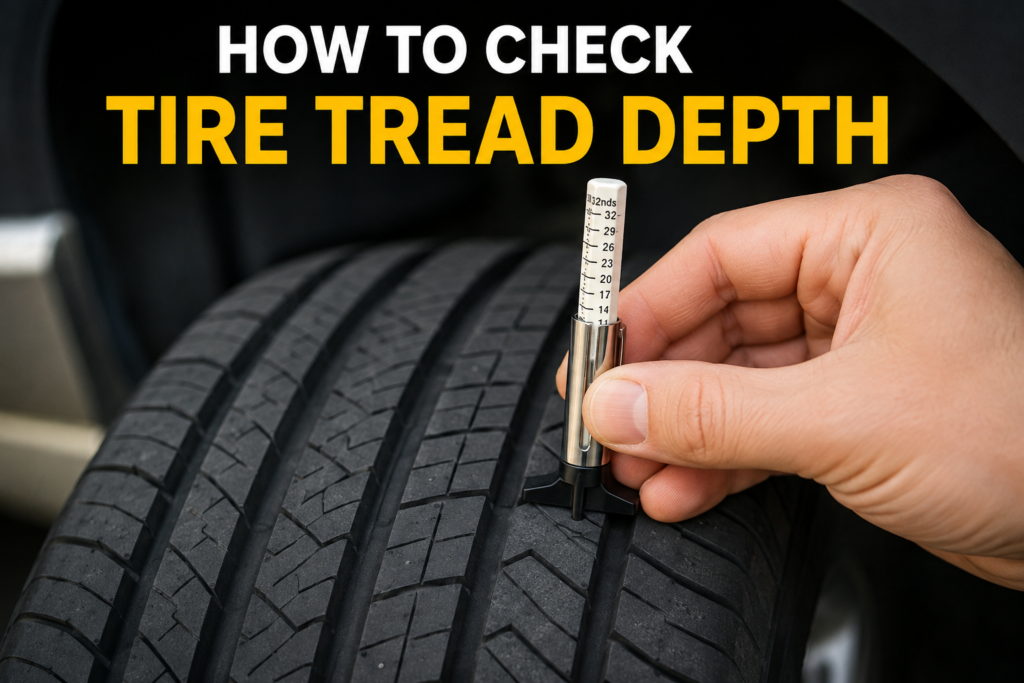
The most accurate and convenient way to check tire tread depth at home is with a tire tread depth gauge. These gauges are inexpensive, small, and easy to keep in a vehicle or garage.
Start by parking your car on a flat and safe surface. Turn the engine off and make sure the vehicle is secure. It is easier to inspect the tires when the steering wheel allows you to see the tread clearly.
Next, place the gauge into one of the main grooves of the tire. Make sure the measuring end reaches the bottom of the groove and that the gauge is sitting straight.
Read the measurement shown on the gauge. Many gauges display tread depth in 32nds of an inch, while some show millimeters.
Do not rely on only one measurement. Check several locations across the tread, including the inner, center, and outer portions. I recommend taking measurements at different points around the tire as well.
For example, if the outer tread measures 7/32 inch but the inner tread measures only 4/32 inch, the tire is not wearing evenly. That difference is worth investigating even if the average tread depth appears acceptable.
How to Check Tire Tread Depth Without a Gauge
If you do not have a tread depth gauge, you can perform a quick visual inspection using the tread wear indicators built into most modern tires.
These small raised bars are located inside the main grooves of the tire. They are designed to indicate when the tread has worn significantly. When the surrounding tread becomes level with these indicators, the tire has reached a very low tread depth and should be replaced.
Another traditional method involves using a coin as a basic visual check. However, coin tests are not as precise as using a proper tread depth gauge. They can give you a rough indication, but they should not replace an accurate measurement when you are concerned about tire condition.
If I am checking tires before a long road trip, I would personally use a tread depth gauge rather than depending only on a visual inspection.
Understanding Tire Tread Depth Measurements
Tire tread depth is commonly measured in 32nds of an inch in the United States and in millimeters in many other countries.
A measurement around 10/32 or 11/32 inch can be typical for a new passenger tire, depending on its design. As the tread decreases, the tire gradually approaches the point where replacement becomes necessary.
A commonly used minimum tread depth for many passenger tires is 2/32 inch. However, reaching the legal or commonly accepted minimum does not mean the tire suddenly becomes ideal for every driving condition. Wet weather performance can become a concern well before the tire reaches the absolute minimum.
For that reason, I would not wait until a tire is completely worn to start thinking about replacement. If the tread is getting low, especially if you frequently drive in heavy rain, it is sensible to start planning for new tires.
Always consider the tire manufacturer’s recommendations and the regulations that apply where you drive.
Check All Four Tires
One mistake I often see is focusing on only the front tires. All four tires deserve attention.
Depending on the vehicle, driving style, tire type, and maintenance condition, the front and rear tires can wear at different rates. Front tires on many front wheel drive vehicles can experience more work because they handle steering and acceleration.
When checking tire tread depth, measure all four tires and compare the results. If one tire has dramatically less tread than the others, there may be an underlying problem.
The spare tire should also be inspected occasionally. A spare that has been sitting unused for years may still have plenty of tread but could have other age related concerns.
Look for Uneven Tire Wear
Tread depth is only one part of tire inspection. I always recommend looking closely at the tread pattern while taking measurements.
If the tire is wearing more heavily on the inside edge, it may indicate an alignment issue. If the outside edge is wearing faster, alignment or tire pressure could be involved.
Wearing in the center of the tread can sometimes be associated with excessive tire pressure, while excessive wear on both shoulders can be associated with underinflation. There can be several causes, so these patterns should not automatically be treated as proof of one specific problem.
You may also notice cupping, scalloping, cracks, bulges, or objects stuck in the tire. These issues deserve attention even when the tread depth measurement looks good.
Check Tire Tread Depth When the Tires Are Cold
For consistency, it is useful to inspect tires when they are cool and have not been driven extensively. Heat changes tire pressure and can make inspection less convenient.
If you are checking tread depth, make sure the gauge is positioned properly in the groove and does not rest on one of the raised tread blocks.
Small measurement errors can happen if the gauge is held at an angle or placed incorrectly. Taking several readings is a simple way to get a more reliable picture of tire wear.
When Should You Replace Tires?
There is no single number that tells the complete story of tire condition. Tread depth is important, but age, damage, wear pattern, tire construction, and driving conditions also matter.
If the tread has reached the manufacturer’s replacement recommendation or the legal minimum in your area, replacement should be taken seriously.
I would also consider replacing a tire if it has serious damage, visible structural problems, deep cracks, or other signs of deterioration. A tire with acceptable tread depth is not automatically safe if it has significant damage.
If you are unsure, having a qualified tire professional inspect the tire is a sensible choice.
How Often Should You Check Tire Tread Depth?
There is no need to make tire tread inspection complicated. I believe checking the tread once a month is a good habit for most drivers. You can also inspect the tires whenever you check tire pressure.
It is especially useful to check before a long journey, during seasonal changes, or when you notice something unusual about the vehicle.
For example, if the steering wheel starts vibrating, the vehicle pulls to one side, or the tires become noticeably noisy, I would not ignore those signs. They can sometimes point toward tire, wheel, alignment, or suspension problems.
Tips for Maintaining Good Tire Tread
Proper tire maintenance can help tires wear more evenly and last longer. Check tire pressure regularly and follow the recommended pressure listed by the vehicle manufacturer.
Wheel alignment should also be checked when necessary, particularly if you notice uneven tread wear or if the vehicle has experienced a strong impact from a pothole or curb.
Tire rotation can help promote more even wear on vehicles where rotation is recommended. Follow the vehicle and tire manufacturer’s guidance because not every tire setup can be rotated in the same way.
Avoid aggressive driving whenever possible. Hard acceleration, heavy braking, and fast cornering can increase tire wear.
Final Thoughts
Learning how to check tire tread depth is one of the easiest ways to become more aware of your vehicle’s condition. You do not need expensive equipment or advanced mechanical knowledge. A simple tread depth gauge can tell you a lot about how much usable tread remains, while a careful visual inspection can help you identify wear patterns and possible damage.
From my point of view, the biggest mistake is waiting until the tires look completely worn before checking them. Regular inspections give you an opportunity to notice changes early and plan for maintenance before the situation becomes urgent.
Remember to check the entire tread, compare all four tires, look for uneven wear, and pay attention to damage as well as tread depth. If a tire is approaching its replacement limit or you are unsure about its condition, getting professional advice is the safest approach.
Good tires are an important part of safe driving. Spending a few minutes checking tire tread depth can help you make better maintenance decisions and feel more confident every time you get behind the wheel.